
His mother, Diane Ashworth, had organized the shower. She’d chosen the venue,
the menu, the guest list. I’d been allowed to attend, which I gathered was
generous of her.
I waited until the gift opening portion. Megan sat in a white wicker chair
surrounded by boxes wrapped in designer paper. A Bugaboo stroller from Bradley’s
college roommate, a cashmere blanket set from Diane, silver rattle from
Tiffany’s. Each gift unwrapped to polite applause.
Then mine. I’d wrapped it in brown paper because I liked the simplicity, tied it
with twine. Megan picked it up, and I saw that flicker cross her face, the same
one she got whenever I showed up somewhere her new family could see me. A quick
scan of the room. Who’s watching?
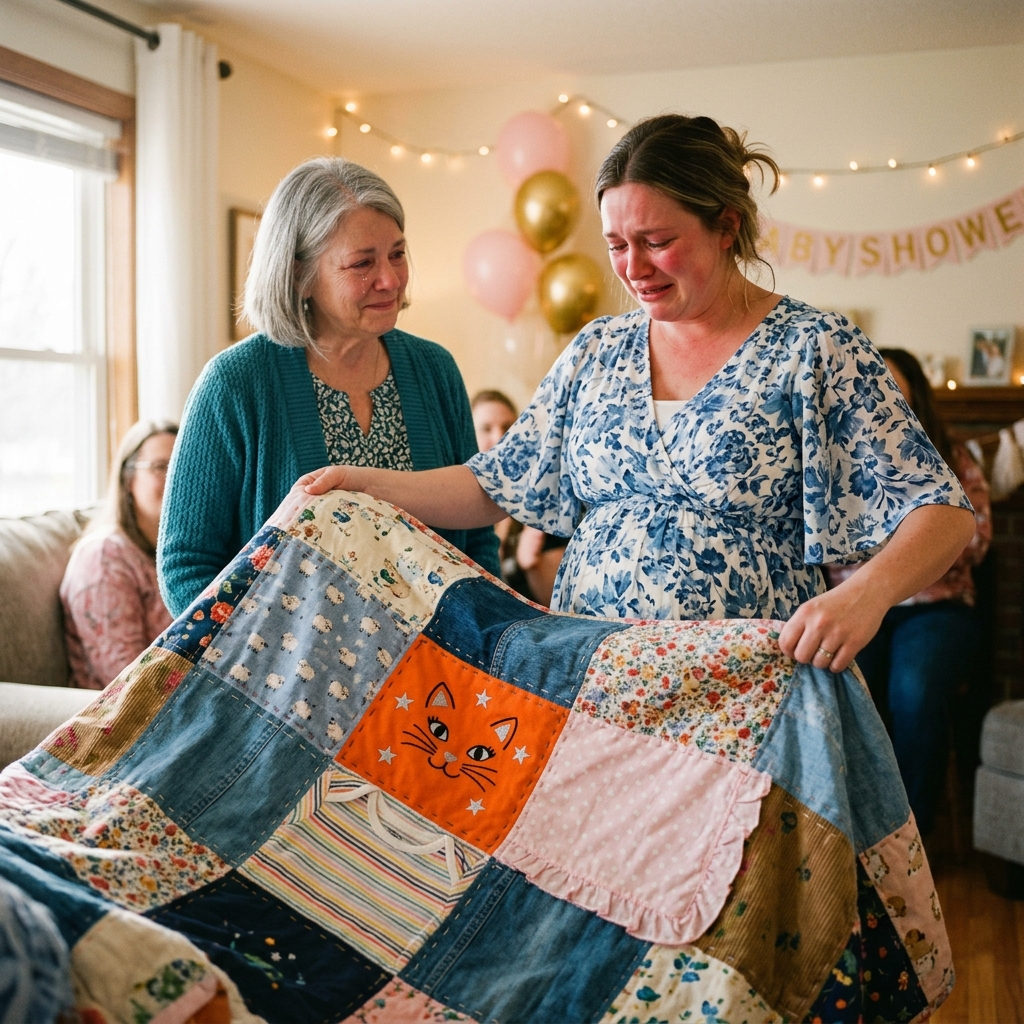
She untied the twine and unfolded the quilt. I’d spent 9 months on it. Every
night after my shift at Brookhaven Senior Center, where I cooked three meals a
day for 80 residents, I sat at my kitchen table and sewed. Each square was
labeled in tiny embroidered letters. Megan’s first blanket, 1994. Halloween
butterfly, 1998. Birthday dress, 2000. 30 squares. 30 memories stitched together
for her baby.
Megan held it up. The room went quiet. Diane leaned in first. “Oh my.” She
touched the fabric between two fingers like she was checking for disease. “Is
this homemade?”
Megan’s cheeks turned pink. “Mom, we registered at Pottery Barn.”
I started to explain, started to tell her about the 9 months of sewing, about
the squares, about what each piece of fabric meant, but Bradley spoke first.
“Your mother’s a lunch lady, babe.” He said it with a grin like it was a joke
everyone was in on. “What did you expect? A gift card to Bergdorf’s?”
Laughter. Not cruel laughter, exactly. The polite kind. The kind that lets you
know you don’t belong here.
Megan set the quilt on the gift table on top of the discarded wrapping paper.
She didn’t fold it. She didn’t look at me. She turned to the next gift, a
designer diaper bag from one of Bradley’s colleagues, and the room moved on.
I sat there for another 10 minutes. Nobody spoke to me. Diane was across the
lawn whispering to another woman, both of them glancing in my direction. I
caught the word cafeteria.
I stood up, walked to the gift table, and picked up the quilt. I folded it the
way I fold everything, with care, with patience. Then I put it in my bag and
walked to my car.
The parking lot was full of BMWs and Mercedes. My Honda Civic sat at the far end
next to a service entrance. I got in, put the quilt on the passenger seat, and
sat there for a while. I didn’t cry. I stopped crying over my daughter’s
choices 3 years ago, the day she told me not to come to her engagement party
because Bradley’s family might feel uncomfortable. I went anyway. She pretended
I was a friend of the family.
That night, I sat in my apartment in Astoria. Same apartment I’d lived in for 28
years, rent-stabilized, $1,100 a month, one bedroom, a kitchen barely big enough
to turn around in, and a window that overlooked the elevated train tracks.
Every 14 minutes, the whole place shook.
I made myself tea and opened the closet in the hallway. Behind the winter coats,
there was a filing cabinet, fireproof, bolted to the floor. I’d bought it
in 2001 when the buildings fell and I realized nothing in this world was
permanent except what you secured yourself. I unlocked the top drawer.
Inside, 34 property deeds filed alphabetically by borough, Queens, Brooklyn, the
Bronx, Manhattan, and three in Westchester County. Purchase records going back
to 1997. Stock certificates. Municipal bond portfolios. And one deed that
mattered more than all the others tonight, Ashworth Country Club, 40 acres,
acquired in 2021 through RMD Holdings LLC, my initials, Rosemary Delgado.
Purchase price, $3.8 million. Current appraised value, $6.2 million.
My daughter had just been humiliated at a baby shower hosted at a venue her
mother owned.
It started in 1997. I was 35, widowed, raising Megan alone on a cafeteria
worker’s salary, 22,000 a year plus whatever overtime I could grab. My husband,
Eddie, had died 2 years earlier. Heart attack at 41, no life insurance because
we couldn’t afford the premiums. He left me, Megan, and $4,200 in a savings
account.
I was working the kitchen at PS 117 when I overheard two teachers talking about
a foreclosed row house in Jamaica, Queens. Bank was selling it for 62,000.
Everyone said the neighborhood was too rough, the building too old. I bought it
with everything I had, including a loan I shouldn’t have qualified for. The bank
officer felt sorry for me, I think. Widowed cafeteria worker with a 3-year-old.
He pushed the paperwork through.
I spent weekends fixing that row house. Library books taught me plumbing.
YouTube didn’t exist yet, but the hardware store on Hillside Avenue had a
retired contractor named Gene who answered questions for free if you bought your
supplies from him. I learned drywall, electrical, tiling. Megan played on the
floor with her dolls while I replaced pipes.
I rented both units to families like mine, single parents working hourly jobs.
The rent covered my mortgage. Within 3 years, I bought a second property, then a
third. Every extra dollar went into the next building. I never bought new
clothes, never took vacations, never ate at restaurants. By 2010, I owned 12
properties. By 2020, 28. When COVID hit, I didn’t raise a single tenant’s rent.
Some of them couldn’t pay at all. I let them stay. A few of those tenants are
still in my buildings today, paying the same rate they paid in 2019.
The total portfolio now, 34 properties across New York. Estimated value, $28
million. Annual rental income after expenses, $1.4 million. And I still worked
the cafeteria at Brookhaven Senior Center. 5 days a week. 5:30 a.m. to 2:00 p.m.
Scrambled eggs, oatmeal, lunch specials. My co-workers called me Rosie. The
residents called me sweetheart. Nobody called me a millionaire because nobody
knew.
I never told Megan because I wanted her to understand something Eddie and I both
believed. You earn your place in this world. You don’t inherit it. I thought if
she grew up without money, she’d develop the kind of character that money can’t
buy. I was wrong. She developed the kind of shame that money makes worse.
The next morning, I didn’t go to my attorney. I went to the bank first. First
Metro Credit Union on Steinway Street, where I’d kept my liquid savings for 20
years. The account held $4.6 million, emergency money separate from the
properties. The branch manager, Paul Keenan, had known me for 15 years. He’d
watched the balance grow from five figures to seven without ever asking
questions. That was one of the things I liked about Paul. He understood that
quiet money was real money.
“Rose.” He shook my hand in his office, the door closed. What can I do for you?
I need to move everything, all of it. Cashier’s checks made out to myself, and I
need my full transaction history for the past 5 years.
Paul nodded slowly. That’s a significant withdrawal. Is everything all right?
Everything’s fine. I just need access to my own money. He didn’t push. 20
minutes later, I walked out with a leather folder and a sealed envelope of
records.
My next stop was Arthur Harmon’s office. Arthur was my attorney, had been
since 2003 when I needed someone to set up my LLC. He was 70 now, semi-retired,
but he still handled my affairs because, as he put it, I was the most
interesting client he’d ever had. His secretary, Linda, was the one who called
him out when she saw my documents.
Arthur appeared in the doorway of his office in reading glasses and a cardigan.
He looked at the folder I’d placed on Linda’s desk. Rose, what’s going on?
I need a full asset review. Every property, every account, every LLC, and I need
you to set up a meeting with a private investigator, someone who handles
financial fraud.
Arthur’s eyebrows went up, but he didn’t argue. He never did. By that afternoon,
I was sitting across from a woman named Katherine Voss, former forensic
accountant turned investigator, mid-50s, sharp eyes, no small talk. Arthur had
used her on three cases, all successful.
Mrs. Delgado, she opened a notebook. Tell me what you need.
My son-in-law, Bradley Ashworth. He works at Ashworth and Klein Insurance. His
lifestyle doesn’t match his salary, and I want to know why.
Katherine didn’t blink. What makes you suspicious?
I’d been watching Bradley for 3 years, the cars, the watches, the vacations to
St. Barts. His salary at his father’s firm was around 90,000. His wife, my
daughter, didn’t work. They lived in a house that cost $1.2 million with a
mortgage payment that should have eaten half his take-home pay. The math didn’t
work.
I explained all of this to Katherine. She wrote it down without comment. Give
me 2 weeks, she said.
Katherine Voss called me on a Tuesday evening. I was in my kitchen, the quilt
spread across the table. I’d been looking at the squares, Megan’s first steps,
her kindergarten graduation, the fabric from the dress she wore to her father’s
funeral, pale blue with white flowers. She’d been 5 years old, holding my hand,
asking why daddy was sleeping in a box.
Mrs. Delgado, Katherine’s voice was steady. I have the results. You’re going to
want to sit down.
I’m already sitting.
Bradley Ashworth has been running a premium diversion scheme for the past 2
years. He collects insurance premiums from clients, deposits them into a shadow
account instead of the company’s operating fund, and uses the money for personal
expenses. Total diverted so far, $720,000.
I felt cold. Not surprised, exactly. I’d suspected something, but hearing the
number, hearing that my daughter’s lifestyle was built on stolen money, that was
different.
Katherine continued, it gets worse. Several of his clients are elderly, retirees
on fixed incomes who think they have active life insurance and long-term care
policies. They don’t. Their premiums went into Bradley’s pocket. If any of them
file a claim, there’s nothing there. No coverage, no payout, nothing.
I closed my eyes. Elderly people, people like the residents I cooked for every
day at Brookhaven, people who trusted that when they paid their premiums,
someone was protecting them. Does my daughter know?
I found no evidence that Megan is aware. Her name isn’t on any of the shadow
accounts. She has no access to the firm’s financials. As far as I can tell, she
thinks they’re living on Bradley’s salary and family money.
What about his father? Edmund Ashworth?
That’s where it gets complicated. Edmund recently retired, turned day-to-day
operations over to Bradley 18 months ago. The scheme started shortly after. I
believe Edmund doesn’t know, but I can’t be certain yet.
I need everything you have, documentation, account records, all of it.
I’ll send an encrypted file tonight. And Katherine, thank you.
Mrs. Delgado, what are you going to do with this?
I’m going to protect my daughter, and then I’m going to protect the people
Bradley stole from.
I spent the next 3 days at my kitchen table reading through Katherine’s report.
Every transaction documented, every fake policy traced, every elderly client
listed by name with the premiums they’d paid and the coverage they thought they
had but didn’t. 62 clients, average age 74, total premiums diverted $720,000.
Mrs. Patricia Hollowell, 81, paid $380 a month for long-term care insurance
for 4 years. Her policy was void. If she needed nursing care tomorrow, she’d
have nothing. Mr. and Mrs. David Chen, both 76, paid $12,000 annually for a
joint life insurance policy. None of it had been processed. If either of them
died, the surviving spouse would receive nothing.
I knew people like this. I fed people like this every single day. I made their
oatmeal and cut their toast into triangles and refilled their coffee cups and
asked about their grandchildren. These were the people Bradley Ashworth was
stealing from so his wife could carry a handbag that cost $4,000.
I picked up the phone and called the New York State Department of Financial
Services. I filed a formal complaint, case number, detailed evidence, everything
Katherine had found. The investigator I spoke with, a man named Agent Rivera,
was quiet for a long time after I finished.
Mrs. Delgado, this is serious. This could result in criminal charges.
I understand.
And your daughter is married to this man.
I know who my daughter is married to.
There was a pause. We’ll open a formal investigation. It may take several weeks
before we act. Please don’t alert Mr. Ashworth.
I won’t.
After I hung up, I sat in the silence of my apartment. The train rattled past.
The walls shook. I looked at the quilt on the table, at the square labeled
Megan’s first blanket, 1994, and I thought about the woman my daughter had
become. Then I picked up the phone again and called Philip Garrett, my property
manager.
Philip, I need to talk about the Ashworth Country Club.
Philip managed seven of my properties. He’d been with me since 2015, reliable,
sharp, no questions he didn’t need to ask. What’s on your mind, Rose?
I want to convert it. The entire property. 40 acres, all of it. Senior housing,
affordable units for retirees on fixed incomes, independent living, some
assisted, a community center, green space. I’m thinking 120 units.
Philip was quiet for 10 seconds. Rose, that club generates $800,000 a year in
membership fees.
I know what it generates.
You want to tear down a profitable country club and build senior housing?
I want to build something that matters. Can you start on feasibility?
He exhaled. I’ll have architects on it by Friday.
I want it called Hollowell Commons.
After who?
After a woman named Patricia Hollowell. She’s 81, and she’s been paying
insurance premiums for 4 years on a policy that doesn’t exist.
Philip didn’t ask anything else. He just said, I’ll make it happen.
Megan called 14 times over the next week. I let every call ring through to
voicemail. I was at work when most of them came in. Morning shift at Brookhaven,
I made French toast for breakfast, chicken soup for lunch. Mrs. Okonkwo in
room 214 asked for extra cinnamon on her oatmeal. Mr. Patterson in 118 told me
the same joke he tells every Tuesday about a priest and a fisherman. I laughed
like it was the first time. My phone sat in my locker, buzzing.
On my break, I listened to the voicemails.
Voicemail one. Mom, I feel bad about the shower. Can we talk? I know Bradley was
rude. He didn’t mean it.
Voicemail five. Mom, something weird is happening. Bradley’s been on the phone
all night. He won’t tell me what’s going on. He snapped at me when I asked.
Please call me back.
Voicemail nine. Mom, two men came to Bradley’s office today. He told me it was
nothing, just a compliance review, but he looked scared. Mom, I’m 7 months
pregnant. I need you.
Voicemail 14. Mom, please. I don’t know what’s happening. Bradley won’t look at
me. His father called screaming. I heard something about missing premiums. Mom,
what is going on? Are you doing this? Did you do something?
I put the phone back in my locker and went back to the kitchen. The soup needed
stirring.
2 weeks after I filed the complaint, I called Agent Rivera.
Mrs. Delgado, we have enough to move forward. The evidence is solid. We’ve
confirmed the shadow accounts, the diverted premiums, the fraudulent policies.
We’re preparing to make an arrest.
I need you to wait 5 more days.
Silence. 5 days. Next Saturday. At the Ashworth Country Club.
Mrs. Delgado, this isn’t a television show.
No, it’s not. It’s my daughter’s life. She’s pregnant. She’s married to a man
she doesn’t really know. If you arrest him at his office on a Tuesday, she’ll
think it’s a mistake. She’ll defend him. She’ll blame me. She needs to see it
herself in a place that means something.
Agent Rivera sighed, you own the property.
I do, and you’ll be present.
I will.
So will my daughter. So will Bradley and his mother. Five days, Mrs. Delgado.
After that, we proceed regardless.
Understood? I circled Saturday on my calendar in red ink and went to bed. In
five days, my daughter would learn that her husband had been stealing from the
elderly. In five days, she’d learn that her mother owned the ground she was
standing on. In five days, everything would change.
I spent those five days doing what I always do. I went to work. I made breakfast
for 80 residents. I refilled coffee cups and wiped down tables and said good
morning to people who remembered my name even when they couldn’t remember their
own children’s.
On Wednesday, I visited Patricia Hollowell. She lived in a small apartment in
Yonkers, second floor, no elevator. She answered the door in a housecoat with a
cup of tea in her hand. 81 years old, white hair pinned up, sharp eyes behind
thick glasses.
Mrs. Hollowell, my name is Rose Delgado. I’m not selling anything. I just wanted
to ask you a question about your insurance.
She invited me in. Her apartment was tidy, warm, filled with photographs of
grandchildren. We sat at her kitchen table.
Your long-term care policy through Ashworth and Klein, I said carefully. Have
you ever tried to use it?
She shook her head. I pay every month, $380. It’s a lot on my pension, but my
daughter insisted. She said if I ever needed help, it would cover everything.
I looked at this woman, this grandmother with her tea and her photographs, and I
thought about Bradley Ashworth dropping my quilt on the table like it was
garbage. Mrs. Hollowell, I’m going to make sure you’re taken care of. I can’t
explain everything right now, but I promise you, by next week, things will be
different.
She studied my face. You’re not from the government, are you?
No, ma’am. I’m a cafeteria cook.
She smiled. Best people in the world, cafeteria cooks. You know that?
I do.
Saturday arrived clear and bright. I got to the country club at noon. Two hours
early. The grounds were empty except for a landscaping crew trimming hedges. I
walked through the main building, through the dining room with its crystal
chandeliers and mahogany panels, through the ballroom where members held their
galas. All of it mine. Every chandelier, every panel, every blade of grass.
Philip had already begun preliminary work. An architect’s rendering sat in my
car, Hollowell Commons. 120 units of affordable senior housing built on 40 acres
of land that currently served as a playground for people who’d never worried
about the price of a prescription.
At 1:30, Megan’s car pulled into the lot. She got out slowly, one hand on her
belly. Seven and a half months now. She looked exhausted. Dark circles, hair
pulled back in a messy knot. No makeup. She saw me standing by the entrance and
stopped.
Mom. Her voice cracked. What’s going on? You said to come here. You said it was
important.
It is. Come inside.
Five minutes later, Bradley’s black Range Rover pulled in. He got out looking
like he hadn’t slept in days. Wrinkled shirt, jaw clenched. Diane Ashworth
followed in her own car, heels clicking on the pavement. They walked in
together.
Bradley saw me and his eyes narrowed. What is this? Why are we here?
Sit down, I said. All of you.
We stood in the main dining room. Late afternoon light came through the tall
windows. The room smelled like furniture polish and old money.
Bradley crossed his arms. I don’t have time for this. Megan, let’s go.
Megan didn’t move. She was looking at me. Mom, just tell me what’s happening.
This building, I said. This club. I own it.
The silence lasted five full seconds. Diane laughed. Excuse me?
I own the Ashworth Country Club. Purchased it in 2021 through my LLC. 40 acres.
Every building. Every piece of furniture you’re looking at. It’s mine.
Bradley’s face went slack. That’s impossible. You’re a cafeteria cook.
I am. I also own 33 other properties across New York. Total portfolio value, $28
million. I’ve been investing in real estate since 1997.
Megan sat down in the nearest chair. Her hands were shaking. Why didn’t you tell
me?
Because I wanted to know who you’d become without it. And now I know. I looked
at her steadily. You became someone who lets her husband call your mother a
lunch lady in front of 60 people. You became someone who throws away a handmade
quilt because it doesn’t come from Pottery Barn.
Mom, that’s not fair.
It’s accurate.
Before Megan could respond, the front door opened. Agent Rivera walked in, badge
visible, followed by two other investigators.
Bradley went white.
Mr. Ashworth? Agent Rivera’s voice was calm and professional. I’m Agent Rivera
with the New York State Department of Financial Services working in coordination
with the FBI. We need to speak with you regarding irregularities at Ashworth and
Klein Insurance.
Bradley took a step back. This is ridiculous. My father’s firm has been
operating for 30 years without a single complaint.
Your father’s firm was clean. Agent Rivera opened a folder. Your management was
not. We have documentation of $720,000 in diverted client premiums over the past
two years. 62 clients, most of them elderly retirees, are currently holding
policies that have no backing whatsoever.
Diane grabbed Bradley’s arm. This is absurd. Who filed this complaint? She
turned to me. You. You did this.
I provided evidence of criminal activity, I said. That’s what any person with a
conscience would do.
Bradley’s composure shattered. You don’t understand the pressure I was under.
The firm was losing clients. The overhead was killing us. I was going to put it
back. Every cent.
Agent Rivera shook his head. Mr. Ashworth, you used diverted premiums to fund
personal expenses. A Range Rover, country club dues, a vacation property in the
Hamptons. None of that money was going back.
It was temporary. Bradley was shouting now. Lauren, tell them. Tell them I’m a
good person. Tell them your mother is doing this because she’s bitter. She’s a
lunch lady who’s jealous of everything we’ve built.
The word echoed in the dining room, jealous.
Megan looked at me, then at Bradley, then at the agents. 62 clients? She
whispered.
Elderly clients, I said quietly. People on fixed incomes. People who thought
they had insurance. People like the residents I cook for every day.
Megan’s hand went to her belly. Her face crumpled.
Agent Rivera stepped forward. Mr. Ashworth, I’m placing you under arrest for
insurance fraud, grand larceny, and elder financial exploitation.
No. Bradley backed toward the door. Megan, do something. Tell them.
She didn’t move. She just sat in the chair, both hands on her pregnant belly,
staring at the man she’d married like she was seeing him for the first time.
The handcuffs clicked. Diane was sobbing. Bradley was still talking, still
explaining, still insisting it was temporary. Agent Rivera let him out.
The dining room fell silent.
Still with me? Comment below. If you were in my position right now, would you
feel justified or heartbroken? Drop your answer. And if you’re still here, what
happened next changed everything.
After the agents drove away, the club was quiet. Diane had stumbled to her car
without a word. Just the click of her heels on tile, then the slam of a car
door, then gone. Megan sat in that dining room chair for 20 minutes without
speaking. I stood by the window and waited. I’d learned a long time ago that the
most important conversations happen in the silence between words.
Finally, she spoke. You knew before the shower.
Three weeks before. I hired an investigator.
Why didn’t you tell me?
Would you have believed me?
She flinched. I don’t know.
Yes, you do.
She was quiet again. Then, he said he loved me. He said we were building a life
together.
He was building a lie. And you were living in it.
Is my baby going to be okay?
Your baby is going to be fine. I walked over and sat down across from her. Your
baby has a grandmother who owns 34 buildings and has $4.6 million in the bank.
Your baby is going to be more than fine.
Megan looked at me. Mascara was streaming down her cheeks. Why did you live like
that? The apartment in Astoria, the cafeteria job. If you had all this money,
because your father and I believed that work gives you dignity. Any work.
I looked around the dining room. I bought my first property with money I saved
from cooking school lunches. I built everything by hand, just like I built that
quilt. Stitch by stitch. Dollar by dollar. And I wanted you to understand that.
But I didn’t.
No. You didn’t.
She broke down. Really broke down. The kind of crying that comes from somewhere
deeper than sadness. Shame, maybe. Or recognition. or the weight of
understanding. Finally, what she’d thrown away.
“I’m so sorry, Mom. I’m so sorry for everything. I know. Can you forgive me?”
I already have, but forgiveness isn’t the hard part. The hard part is what comes
next.
What comes next?
I pulled out my phone and showed her the architect’s rendering. Hollowell
Commons, 120 units of affordable senior housing. Right here, on these 40 acres.
She stared at the image. “You’re tearing down the country club?”
“I’m building something better. Named after a woman named Patricia Hollowell.
She’s 81. She’s been paying your husband $380 a month for insurance that doesn’t
exist.”
Megan’s face went pale.
“Every dollar Bradley stole came from someone’s grandmother,” I said. “Someone’s
mother. Someone who worked their whole life and trusted that the system would
protect them.” I paused. “I’m going to make it right.”
Megan wiped her eyes. “What can I do?”
“That depends. Are you willing to work?”
Megan moved back to Queens the following week into my building on 31st Avenue, a
two-bedroom unit I’d kept vacant. She filed for divorce the same month.
Bradley’s father, Edmund, upon learning the full scope of what his son had done,
cooperated with investigators and began the process of reimbursing every
defrauded client from the firm’s reserves.
Megan started working for Philip, my property manager. Entry level. Answering
phones, filing paperwork, learning the business from the ground up. She didn’t
complain. Not once.
Her baby, a girl, was born in November. She named her Rose.
Eight months later, I stood on the grounds where the Ashworth Country Club used
to be. The buildings were gone. In their place, rows of newly constructed
apartments. Bright, clean, each one designed for seniors who’d spent their lives
being told they couldn’t afford dignity. Hollowell Commons, 120 units, a
community garden, a medical clinic, a cafeteria where residents could eat
together the way I’d always believed meals were meant to be shared.
Patricia Hollowell cut the ribbon. She cried. Her daughter cried. Half the crowd
cried.
I stood in the back next to Megan, who held baby Rose on her hip. Megan wore
jeans and work boots and a Hollowell Commons staff jacket. She’d lost the
designer bags and the manicured nails. She looked tired and real and like
someone I recognized.
“You built all this,” Megan said quietly, watching families walk into their new
homes. “You built all this from cooking lunches and fixing pipes.”
“I built it from showing up every day. That’s all building is, showing up.”
A man in his 70s walked past carrying a box labeled bedroom. He nodded at me. I
nodded back. He moved into unit 47, a retired bus driver.
“Mom?” Megan’s voice was small.
“Yeah?”
“I keep thinking about the quilt. The one I let Bradley throw on the table.”
“I know. Do you still have it?”
“It’s in my apartment.”
“Hanging on the wall.”
Megan’s eyes filled with tears. “Can I have it? For Rosie?”
I looked at my daughter, at the woman who’d been ashamed of me, who’d let her
husband mock me, who traded her values for a country club membership, and at the
woman standing here now, eight months into the hardest work of her life, holding
a baby named after a cafeteria cook. “When you’re ready,” I said.
She nodded. “How will I know when I’m ready?”
“When you stop asking.”
That night I went home to my apartment in Astoria. Same apartment, same rent,
same view of the elevated train tracks. I could have lived anywhere. I chose
this place because it reminded me where I came from and what mattered. On the
wall above my kitchen table hung two things. The quilt, all 30 squares preserved
behind glass, and a photograph of Eddie, my husband, standing outside P.S. 117
on my first day of work. He’d driven me there in our old Dodge, kissed me on the
cheek, and said, “Rosie, you’re going to feed a lot of kids today.”
He was right. I fed kids for 30 years. Then I fed seniors. Then I built homes
for 120 families who’d been told they couldn’t afford to live with dignity.
My phone buzzed. A text from Megan. “Good night, Mom. Thank you for not giving
up on me. See you at the Commons tomorrow. Philip says I might be ready to
manage a building on my own by spring.”
I texted back, “Good night, sweetheart. I’ll be there.”
Then I looked around my little apartment. One bedroom, one kitchen, one window
that shook every 14 minutes when the train went by. I could afford a penthouse.
I could afford 10 of them. But this place held everything I needed. Not because
it was enough, but because it reminded me that enough is a choice.
For 30 years, people looked at me and saw a lunch lady, a woman in an apron and
hairnet serving oatmeal and wiping counters. They assumed I was poor. They
assumed I was uneducated. They assumed that because my hands smelled like dish
soap, I had nothing of value to offer. My daughter believed that, too. Until she
didn’t.
The quilt wasn’t the gift. The buildings weren’t the gift. The $28 million
wasn’t the gift. The gift was the lesson. Your worth is not determined by your
job title. It’s determined by what you do with the hours you’re given.
And to you listening to this story, remember this. God doesn’t measure your
value by your paycheck. When I was stirring oatmeal at 5:30 in the morning,
exhausted and invisible, I didn’t know God was building something through me.
Every honest hour of work, every dollar saved, every property purchased, every
home built, he was using my hands to shelter people who had nowhere else to go.
God tests us not to break us, but to show us who we really are. When my daughter
dropped that quilt on the table, God was revealing what her heart valued. When
she came back eight months later, willing to start over, he was showing me her
transformation.
Don’t do what I did. Don’t hide your story from the people you love. Don’t wait
for betrayal to teach your children about character. Talk to them. Be honest.
Share your struggles before crisis forces the conversation. I almost lost my
daughter because I chose silence over truth.
If this story meant something to you, leave a comment. Have you ever been judged
for your job? Have you watched someone you love lose themselves in the wrong
life? Share this video with someone who needs to hear that every honest job has
dignity. That cafeteria cooks and bus drivers and janitors are building the
world the rest of us live in. Subscribe to this channel for more real stories
about ordinary people and extraordinary choices. Because your story matters, and
someone out there needs to hear it. Thank you for staying until the very end.
Your time is valuable, and I’m honored you spent it here. Some details in this
story are fictionalized for storytelling purposes. God bless you. And remember,
it wasn’t a raggedy blanket. It was a legacy.