
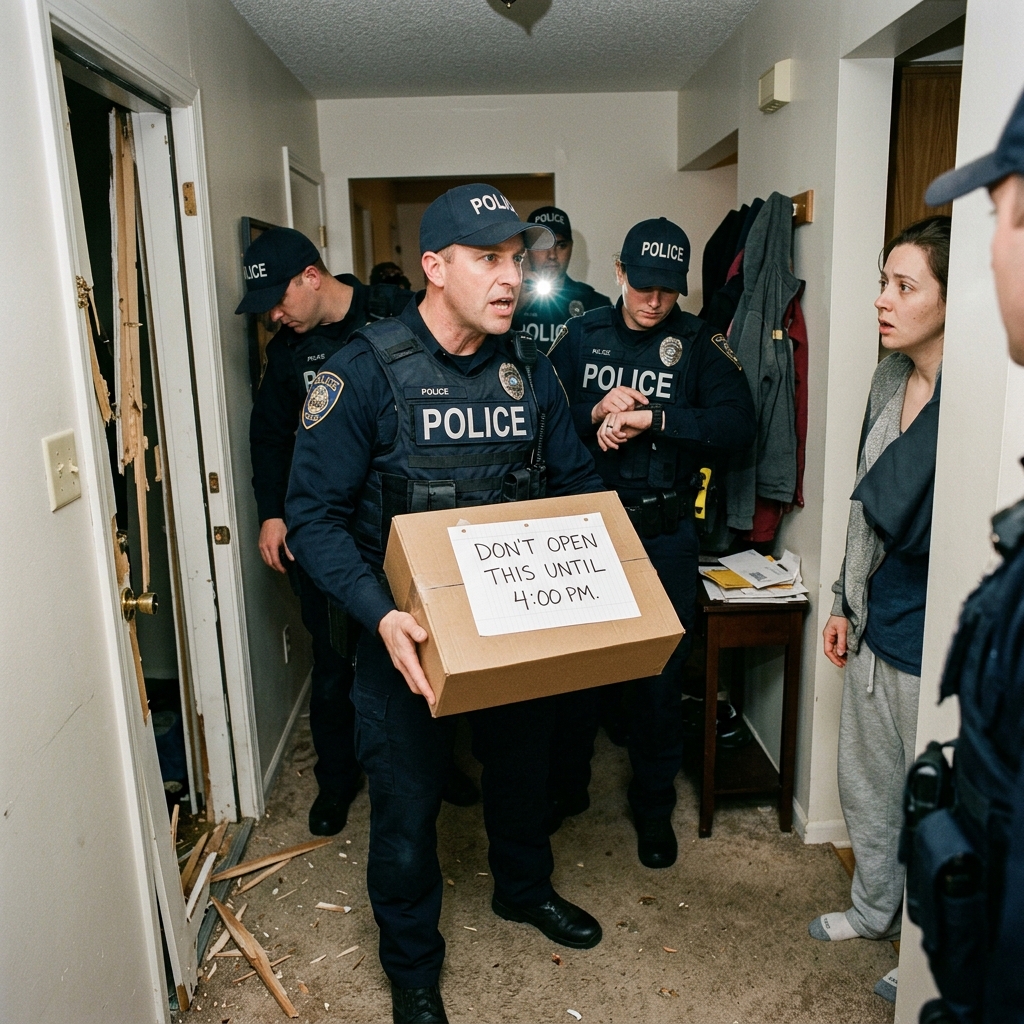
“I received a package in the mail with a note: ‘Don’t open this until 4:00 PM.’ At 3:59 PM, the police broke down my door, demanding I hand it over.”
The package sat on my kitchen table like a coiled viper. It was a nondescript, cardboard box, roughly the size of a shoebox, wrapped in excessive amounts of brown packing tape. There was no return address. The only thing on the label was my name and a neatly typed note taped to the top: “Do not open until 4:00 PM.”
I had found it on my porch at 8:00 AM. It was now 3:45 PM.
For eight hours, I had stared at it. I hadn’t gone to work. I hadn’t answered my phone. I had simply paced the length of my apartment, my coffee growing cold in the mug, my mind churning with every worst-case scenario. Was it a bomb? A joke? A confession? My life was perfectly ordinary—I was a junior actuary for a mid-sized insurance firm—which made the package feel like a glitch in my reality.
At 3:55 PM, the silence of the apartment became unbearable. I walked to the kitchen, my breath hitching in my chest. I picked up a steak knife, my hands trembling. I didn’t want to open it, but the mystery was a physical weight, a magnetic pull I couldn’t resist.
3:58 PM.
I hovered the knife over the tape. My heart sounded like a drum in my ears. I thought about calling the police, but some primal instinct told me to wait. If there was a specific time, it was a test of patience. The air in the apartment felt thin, static-charged. I leaned in, the blade touching the cardboard—
The front door didn’t just open; it disintegrated. The hinges shrieked as the wood splintered inward, sending shards of debris flying across the living room. Before I could even drop the knife, three men in matte-black tactical gear swarmed through the threshold, their rifles raised, their faces obscured by opaque visors.
“DOWN! ON THE GROUND! NOW!”
The commands were barked with a terrifying, rhythmic precision. I fell to my knees, pressing my forehead into the cold hardwood, my hands splayed wide. One of the men was on me in seconds, his boot pinning my shoulder to the floor while his partner swept the room with a laser sight.
“Clear,” the second man grunted.
“Secure the package,” the leader ordered.
I watched, helpless, as a gloved hand reached for the box on my table.
“Wait!” I screamed, the words muffled by the floor. “You can’t! The note—it says four o’clock! If you open it before—”
“Shut him up,” the leader snapped.
The man holding the package hesitated. He looked at his watch, then back at the box. He didn’t look like a cop; there were no badges, no department markings. These were professionals, the kind of men who worked for entities that didn’t exist on paper.
“Sir,” the man with the package said, his voice tense. “The signal is active. It’s a proximity trigger. If we move it, the internal mechanism—”
“I don’t care about the mechanism,” the leader retorted, stepping over me. He grabbed the package himself, his grip careless and aggressive. “If he’s been holding it for eight hours, he’s already compromised. Take him. Bag and tag.”
“You have no right!” I shouted, struggling against the weight on my back. “That’s my property! This is a private residence!”
The leader leaned down, his visor inches from my face. I could see my own distorted reflection in the black glass. “You think this is a residence? You think you’re a person, Elias? You’re a delivery system. And your shift is over.”
He signaled to the third man, who pulled a heavy, grey hood over my head. The darkness was instant, followed by the sharp, metallic tang of a sedative spray.
“Wait,” I gasped, the world beginning to tilt. “The note… who left it?”
“The same person who’s going to erase you,” the leader whispered.
My consciousness began to fray at the edges, the sounds of the apartment—the humming refrigerator, the distant sirens, the rustle of the tape—fading into a dull, rhythmic thrumming. I tried to reach for the table, for the life I’d had ten minutes ago, but my fingers were leaden.
I was hauled to my feet, my boots dragging across the floor. As they shoved me toward the decimated doorway, I heard the leader’s radio crackle to life.
“Target secured. Package is with the team. Proceeding to the extraction point.”
And then, just before the darkness took me completely, a high-pitched beep began to sound from the hallway. A digital, rhythmic chirp. One. Two. Three. Four.
The package didn’t explode. It didn’t start a timer. It started to talk. A voice, calm and eerily familiar, filled the apartment. It was my own voice, speaking words I hadn’t said yet.
“If you’re hearing this, Elias, then they’ve arrived. And if they’ve arrived, you’re already part of the program. Welcome to the other side of the lie.”
The sedative took hold, and the last thing I felt was the sensation of falling—not into the dark, but into a truth so deep it felt like drowning.
The world returned in jagged, nauseating flashes. I wasn’t in a cell, and I wasn’t being interrogated. I was strapped into a leather chair in the back of a moving vehicle—the hum of the engine and the vibrations of the road beneath me suggested a high-speed transit, likely a private jet or a heavy-duty transport truck.
My hands were zip-tied to the armrests, but the hood was gone. The cabin was dimly lit, bathed in the cool, blue glow of recessed LED strips. Across from me sat the leader of the tactical team. He had removed his visor, revealing a face that looked like it had been carved from granite—sharp, angular, and completely devoid of empathy. He was holding the package. It was open.
Inside, there was no bomb. There was a sleek, black tablet and a series of vials containing a clear, viscous liquid.
“You’re wondering why you’re still alive,” he said, not looking up from the tablet. His fingers tapped the glass with clinical rhythm. “It’s a common reaction. Most ‘containers’ go into shock when they realize their autonomy was a programmed illusion.”
“I’m an actuary,” I spat, my voice raspy. “I work in insurance. I have a life. I have a cat. I have a mortgage.”
“You have a file,” he corrected, finally meeting my eyes. “And in that file, you are a biological carrier for an experimental viral vector. We don’t use high-tech servers for deep-storage, Elias. The data is too valuable, too easily hacked. We use human physiology. We use people who are unremarkable, boring, and predictable. People who would never be noticed by counter-intelligence.”
I felt my stomach turn. “You’re saying… you put something in me?”
“You were ‘vaccinated’ three years ago during your annual physical at the company clinic,” he said, his tone as casual as if he were discussing a weather report. “You’ve been carrying a compressed archive of tactical intelligence in your dormant DNA. The package you received today? It wasn’t an item. It was an activation key. A neuro-trigger to bring the data to the surface of your consciousness.”
I blinked, the words sliding over me like oil. Tactical intelligence. Dormant DNA. I looked at the vials in his hand.
“The trigger was set for 4:00 PM because that was the moment your synaptic baseline hit the required threshold for data decompression,” he continued. “But the police—or rather, the ‘competing agency’ that broke down your door—decided they wanted the data for themselves. We got to you first. Lucky you.”
“If you have the data,” I said, my heart pounding in a way that had nothing to do with fear and everything to do with the strange, buzzing static in my brain, “then why do you need me?”
“Because,” he said, clicking a button on the tablet, “the data is encrypted. It requires a biometric handshake. You are the only one who can unlock the contents. You are both the bank and the key.”
He stood up, towering over me. The truck hit a bump, throwing him momentarily off balance, but he regained his stance instantly. He held the tablet toward my face. “Scan your retina.”
“No.”
He didn’t argue. He didn’t even raise his voice. He reached into his belt and pulled out a small, metallic injector. “We have three hours until we reach the drop site. We can do this with your cooperation, or we can do it while you’re in a medically induced fugue state. The result is the same. The data will be extracted.”
I looked at the tablet, then at the man. Something inside me snapped—not into fear, but into the same cold, calculating state I’d felt in the apartment. The static in my brain began to organize itself. Names, maps, passcodes, and faces flickered behind my eyes like a high-speed reel of film.
I knew him.
I didn’t just know his face; I knew his service record. I knew the specific chemical compound in the injector he was holding. I knew that he was prone to chronic migraines, and I knew that he had a daughter who went to a boarding school in Switzerland. The data wasn’t just in me; it was becoming me.
“Agent Miller,” I said, my voice suddenly steady, layered with a calm, predatory authority. “You were recruited out of Fort Bragg in 2012. You were discharged for insubordination, then picked up by the Blackwood Syndicate. Your daughter, Sarah, is currently being held as collateral by your handlers to ensure your loyalty.”
The man—Miller—froze. The injector stopped inches from my skin. His jaw tightened, a muscle twitching near his temple. “How did you get that clearance?”
“I don’t just have the data,” I said, leaning forward as much as the zip-ties allowed. “I have the oversight logs. I have the leverage. If you inject me, the protocol triggers a ‘Dead Man’s Switch.’ The moment my vitals drop below a certain threshold, the locations of every Blackwood asset in Europe are emailed to the Interpol cyber-crimes division.”
I didn’t know if that was true. I was bluffing. But the way Miller’s eyes widened told me that the data in my head was even more dangerous than I had dared to imagine.
“You’re lying,” he whispered, though his hand was shaking.
“Check the tablet, Miller,” I challenged him. “Pull up the log for ‘Project Janus.’ See if my credentials match the administrative override.”
He hesitated. The tablet was glowing, reflecting the conflict in his eyes. He tapped a few commands. His face went pale. He wasn’t just looking at a file; he was looking at his own death warrant.
“You’re not an actuary,” he breathed.
“I’m the person who decides if you’re going to see your daughter tonight,” I replied.
The truck swerved, and for a heartbeat, the power dynamic in the cabin shifted entirely. I wasn’t the package anymore. I was the architect of their destruction.
Miller’s finger hovered over the screen, his breathing shallow. The air in the transport truck had grown thick, charged with the ozone scent of high-end encryption hardware. He looked at the tablet, then at me. The bravado he’d worn like a tactical vest had been stripped away, replaced by the naked terror of a man who realized he was holding a live grenade.
“If I let you go,” Miller whispered, his voice barely audible over the roar of the truck’s engine, “they’ll execute me. My handlers… they don’t leave loose ends.”
“They don’t leave loose ends because they don’t expect their assets to have a memory,” I said. My mind was no longer my own. It was a sprawling, interconnected web of files. I could see the layout of the Blackwood Syndicate’s regional hub—I knew the layout of the ventilation shafts, the shift changes for the guards, and the specific frequency of the electronic locks. “But I have every single one of their secrets. I have the bank accounts they used to fund the coup in the Baltics. I have the home addresses of the board members. I am the greatest threat they have ever faced, Miller. If you help me, you aren’t just a loose end—you’re a ghost.”
“A ghost?”
“They’ll think you died in the explosion,” I said, a dark plan forming in my mind. “We’re two hours from the drop site. The route takes us through the Highland Pass. It’s a dead zone for satellite coverage.”
Miller looked at the side door of the transport, then back at me. He was a man drowning, and I had just thrown him a rope made of fire. He reached into his tactical vest and pulled out a small, serrated blade. He didn’t cut me loose. He held it to the zip-tie, his eyes darting to the cabin’s surveillance camera—a small, black dome in the corner.
“The camera feed,” he muttered. “They’re watching the live stream. If I cut you, they see it.”
“Then don’t cut me,” I said. “Drop the tablet. Give me the override code for the local network. I’ll loop the feed. I’ll make them see us sitting here, waiting for the extraction, while we exit through the floor hatch.”
Miller stared at me for a heartbeat, then his posture slumped. He tossed the tablet into my lap. I didn’t need to look at it. My fingers flew across the glass, my movements guided by a muscle memory that wasn’t mine—it was the data’s. I injected a virus into the stream, a static loop of the last thirty seconds of footage.
“Do it,” I commanded.
Miller moved with the efficiency of a man who had finally chosen a side. He swiped the keycard across the floor hatch, and with a hiss of pneumatic pressure, the panel slid aside. Below us, the blurred gray asphalt of the Highland Pass roared past at eighty miles per hour.
“Jump?” Miller asked, his eyes wide.
“Roll,” I corrected. “And don’t look back.”
We tumbled out of the truck and onto the wet pavement. The world was a blur of grinding noise and agonizing pain as I hit the gravel shoulder, rolling until the momentum bled away. My clothes were shredded, my skin raw, but as I stood up in the biting wind, I felt a surge of cold, artificial clarity. Miller was scrambling to his feet nearby, panting.
The transport truck vanished around the bend, heading toward the extraction point. It would be at least five minutes before the handlers realized the video feed was a loop.
“What now?” Miller asked, clutching his side. “They’ll track the truck. They’ll find the empty cabin.”
“Let them,” I said, looking toward the horizon where the city lights flickered like dying embers. “The Janus Protocol wasn’t just a set of data, Miller. It was a blueprint. My father—or whoever coded me—didn’t want me to hide. They wanted me to be a catalyst. Janus has two faces: one looking at the past, one looking at the future.”
“And which one are you?”
“I’m the one who ends the war,” I said.
I reached into the pocket of my shredded jeans. I had palmed a small, flash-memory chip from the tablet while Miller was busy with the floor hatch. It contained the real-time location of the entire Blackwood Syndicate leadership.
“We’re not running,” I told him. “We’re going to the hub. If I am the archive, then I am the only one who can walk through the front door.”
“That’s suicide,” Miller said, but there was a flicker of something else in his eyes—a desperation to be on the right side of history for once.
“It’s not suicide if you’re a ghost,” I replied.
I started walking down the center of the dark road. I didn’t have a weapon, but I had the names of every man who had signed off on the kidnapping. I had the code to their bank accounts. I had the truth. And in a world built on lies, the truth was the deadliest weapon of all.
As the first light of dawn touched the peaks of the mountains, I felt the data in my head settle, no longer a chaotic storm but a cold, focused intent. Elias Thorne thought he had created a delivery system for secrets. He had accidentally created an executioner.
The Blackwood Syndicate’s regional hub wasn’t a fortress; it was a ghost town. It sat on the edge of the industrial district, a monolithic, windowless concrete slab that looked like it had been abandoned decades ago. But as I approached the perimeter, my consciousness surged. The sensors—invisible infrared grids and seismic motion detectors—were singing to me. I knew exactly where to step.
“Stay behind me,” I said to Miller, who was now armed with a suppressed sidearm and the hollow, terrified look of a man who realized he was walking into his own grave. “If you step an inch to the left, the floor triggers a pressure-sensitive alarm. If you touch the door handle, you trigger a silent pulse that stops your heart.”
“How are you doing this?” Miller asked, his voice trembling.
“I’m not doing it,” I replied, my eyes fixed on the monolithic structure. “I’m just listening to the machine.”
We reached the main entrance—a reinforced steel plate with no visible keyhole. I didn’t need one. I tapped into the building’s local wireless network, my mind weaving through the complex web of firewalls and secondary authentication protocols. It wasn’t like hacking a computer; it was like talking to a living thing. I whispered the digital commands, and with a heavy, grinding sigh, the steel door retracted.
We stepped into the lobby. It was empty, save for the rhythmic humming of the servers that occupied the central shaft of the building. The Syndicate didn’t believe in security guards anymore—they believed in the efficiency of automated defense.
“They know we’re here,” Miller said, raising his weapon. “They have to.”
“They do,” I said. “And they’re waiting for me in the Core. They think if they can kill me, the data dies with me. They still think I’m an actuary.”
We ascended through the guts of the building. With every floor, the pressure in my skull intensified. I was shedding my humanity, bit by bit. I could feel my own memories—my mother’s face, the smell of my apartment, the taste of coffee—being pushed aside by the sheer volume of Project Janus. I was becoming an extension of the database.
We reached the top floor: The Core.
It was a vast, circular room lined with screens, dominated by a single, central chair where Elias Thorne sat. He wasn’t alone. Six tactical operators stood in the shadows, their rifles trained on the doorway.
“Elias,” I said, stepping into the light. I didn’t feel afraid. I felt… optimized.
Thorne stood up. He looked tired. “You shouldn’t have come here, Elias. You’ve exceeded your operational parameters. You were supposed to be extracted, not integrated.”
“Integration wasn’t your choice, Elias,” I said, my voice echoing, perfectly pitched, perfectly calm. “It was the data’s choice. Janus doesn’t like being stored in a box. It prefers to be free.”
“Kill him,” Thorne commanded, gesturing to the guards.
The room erupted in gunfire, but I didn’t move. I didn’t have to. I had already interfaced with the room’s environmental controls.
Clang.
The magnetic locks on the guards’ weapons engaged, pulling the rifles out of their hands and pinning them to the metal walls of the room. The guards stared at their empty palms, frozen in confusion. I flicked my wrist, and the room’s oxygen circulation system reversed, pulling the air out of the chamber, creating a vacuum that dropped them to their knees, gasping.
I walked toward Thorne. He was clutching the armrests of his chair, his eyes wide.
“What are you?” he wheezed.
“I am the end of the Blackwood Syndicate,” I said.
I reached out and placed my hand on the central terminal. I didn’t just upload the data this time. I injected a virus—a recursive loop that would wipe every Blackwood server, every offshore account, and every dirty secret in their history. I watched as the screens began to turn from blue to red. The entire organization was being unmade in real-time.
“You’re destroying it,” Thorne whispered. “You’re destroying everything.”
“I’m resetting the balance,” I said.
The Core began to shake. The building’s power grid, unable to handle the sudden surge of data and the forced shutdown, began to overload. Sparks rained down from the ceiling like a funeral pyre for the Syndicate.
“Miller,” I said, not turning around. “Go. The stairs are clear. The blast doors are open.”
“What about you?” Miller asked, his voice thick with shock.
“The data has to go somewhere,” I said, looking at the screens as they began to black out. “It’s not just a file anymore. It’s me.”
Miller hesitated, then turned and ran. He was a survivor. He knew when a story was over.
Thorne slumped in his chair, watching his legacy evaporate on the monitors. I felt the connection to the world around me fading. My consciousness was expanding, stretching out across the digital fabric of the city, becoming something that wasn’t a man, and wasn’t quite a machine.
I wasn’t Elias anymore. I was the archive.
As the building groaned, the concrete beginning to buckle, I closed my eyes. For one final moment, I remembered the package on the kitchen table. The note: Don’t open this until 4:00 PM.
I finally understood. The note wasn’t a warning for me. It was a message for the world.
The Core exploded in a brilliant flash of white light, a beacon that wiped the darkness from the skyline. When the dust settled, the Blackwood Syndicate was gone, their secrets scattered to the winds.
I was gone, too.
But sometimes, when the wind blows through the canyons of the city, and the servers hum in the deep dark of the night, you can hear a voice. It isn’t a ghost. It isn’t a machine.
It’s just the truth. And the truth is the only thing that never dies.