
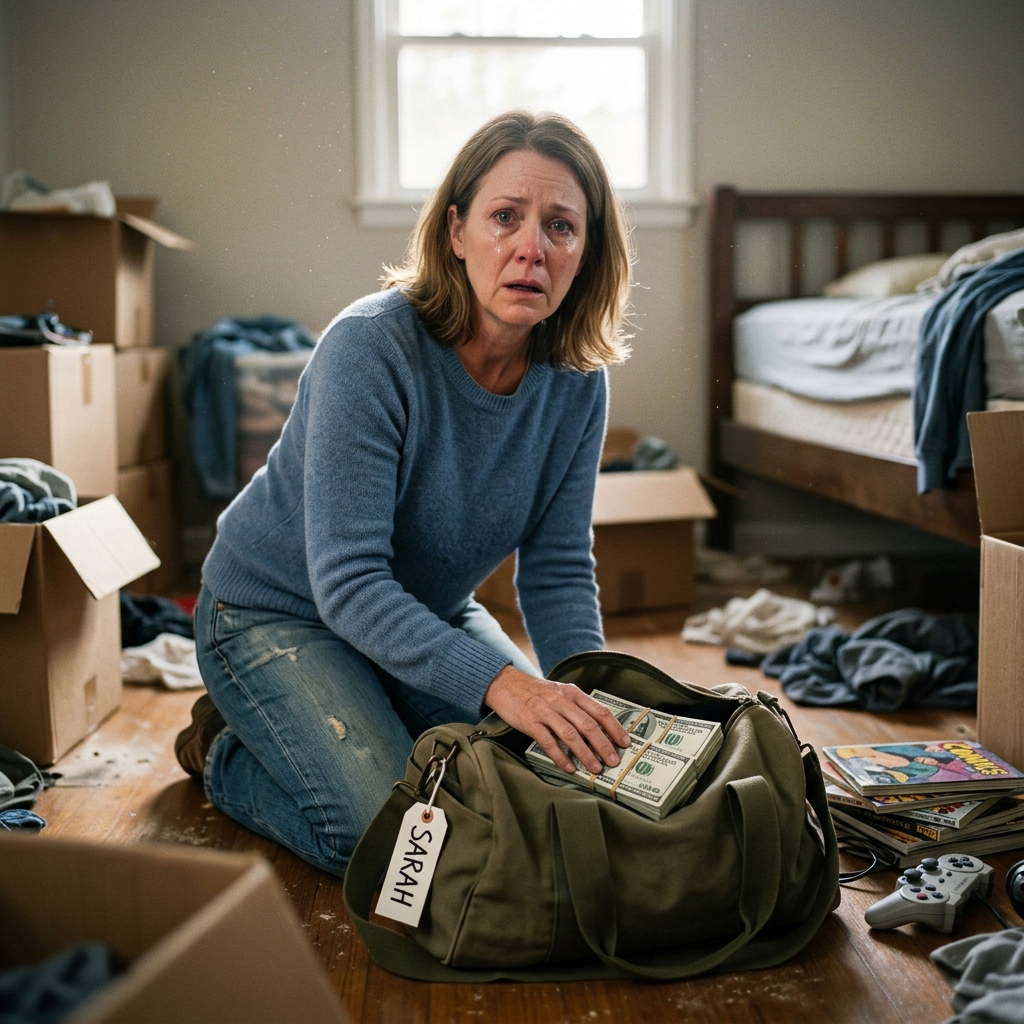
My husband passed after a long illness, leaving me the house and not much else. I charged my stepson, 19, $500 rent. He laughed and said, “You’re childless. I’m your retirement plan-it’s your job to support me.” Furious, I changed the locks. While clearing his room, I found a bag with my name hidden under his bed. I opened it and froze Inside was

The house felt like a hollow shell, its walls echoing with the ghost of Arthur’s labored breathing. It had been six months since the funeral, and the silence was still a physical weight. I had spent everything—every cent of our savings, every bit of my strength—to keep him comfortable in his final years. When the end finally came, it left me with a house that felt too large and a bank account that felt too small.
Leo, my nineteen-year-old stepson, had lived with us through the worst of it. We were two strangers bound by tragedy. I thought we were a team; I thought we were family. But the moment I asked for help, the mask slipped.
“Five hundred dollars a month,” I had said, my voice barely steady. “I’m drowning, Leo. I need you to help with the bills.”
He hadn’t just said no. He had looked at me with a sneer that chilled my blood. “You’re childless. I’m your retirement plan—it’s your job to support me.”
The words hit me like a physical assault. Childless. He had weaponized my deepest sorrow—the fact that Arthur and I had never been able to have children—to justify his own selfishness.
I didn’t argue. I didn’t cry. Something inside me simply fractured.
The next day, while Leo was at the warehouse, I called a locksmith. My hands shook as I watched the technician replace the deadbolts. I felt a grim, icy satisfaction. If I was just a landlord to him, then I could evict him. I went into his room, determined to pack his belongings and leave them on the porch. I wouldn’t be his “retirement plan” any longer. I would be a stranger to him, just as he had proven himself to be to me.
I began to toss his clothes into cardboard boxes, my movements sharp and efficient. I stripped the bed, the sheets smelling of his cologne—a sharp, woody scent that reminded me so much of Arthur it almost brought me to my knees. I pushed aside a heavy, dark-green duffel bag tucked deep under the frame. It was tucked so far back it was nearly invisible, pressed against the floorboards.
I pulled it out, expecting a stash of video games or perhaps clothes he’d forgotten. But as I dragged it into the center of the room, I noticed a piece of masking tape plastered across the front.
My heart skipped a beat. Scrawled in familiar, messy handwriting was my name: Sarah.
I froze. My breath caught in my throat. I sat on the floor, the room suddenly feeling very small. My fingers trembled as I peeled the tape away and unzipped the heavy brass teeth of the bag. Inside, it wasn’t gaming gear or junk.
Inside was a savings passbook, its edges frayed. I opened it and felt the world tilt. Page after page of deposits. Weekly deposits. Every single paycheck he had received since the day he turned eighteen. Beside it, a stack of envelopes, all addressed to me, but never sent.
I picked up the first envelope and opened it. It was a letter, dated three months ago, while Arthur was still fighting for his life.
“Dear Mom,” it started. My eyes blurred. He never called me that. He always called me Sarah. “I know you think I’m just a kid who plays games and ignores the world. You’re so stressed about the doctors and the bills, you don’t see me watching you. I see you crying in the kitchen when you think I’m asleep. I see you skipping dinner so there’s enough for Dad’s medicine. I’m not going to let you end up alone. I’m saving everything. I’m not a kid, and I’m not going to be a burden. I’m going to be your safety net.”
I reached for the passbook again. The balance was staggering. He hadn’t just been saving; he had been sacrificing. He had taken the most grueling shifts at the warehouse, working until his eyes were bloodshot, just to ensure that when the house was paid off, I wouldn’t have to worry about the future.
I felt the air rush out of my lungs. I looked at the bag again, finding a smaller, velvet box tucked in the corner. I opened it to find a set of keys—to a small, efficient apartment, a place I had mentioned once, months ago, as a “dream” if things ever got too hard.
My cruel stepson. My selfish burden.
He hadn’t been laughing at me. He had been laughing at the absurdity of my request, because he was already days away from handing me the keys to our new life. He had wanted to wait until the house debt was cleared to surprise me, wanting to be the man he knew his father would be proud of.
And I had just changed the locks on him. I had just treated him like a villain in the middle of his greatest act of love.
The realization didn’t hit me all at once; it came in waves, each one more agonizing than the last. I sat on the floor of Leo’s room, surrounded by the boxes I had packed with such cold-hearted efficiency. The duffel bag was open, a treasure trove of his secret devotion. Every dollar in that passbook represented a missed movie with friends, a skipped meal, a brutal double shift at the warehouse where he stood on concrete for twelve hours until his arches collapsed.
I looked at the stack of envelopes. They weren’t just letters; they were a roadmap of his maturity. He had been documenting his progress, tracking his savings against the amortization schedule of our mortgage, which I had foolishly left on the kitchen counter for months. He had known exactly how much I was hurting, and he had been doing the math in silence, waiting for the perfect moment to erase my burden.
And I had called him a freeloader. I had told him he was the reason I was struggling. I had looked him in the eye and demanded five hundred dollars, not realizing he had already earmarked ten times that amount for my security.
The sound of a car pulling into the driveway shattered my internal collapse.
I scrambled up, my knees popping, and stumbled toward the hallway. I checked the clock on the wall: 6:15 PM. Leo was home early.
My heart was a panicked bird trapped in my chest. I rushed to the front door, my fingers fumbling with the new deadbolt I had insisted the locksmith install that morning. It was a high-security lock—the kind that didn’t just lock, but engaged—and I realized with a jolt of pure horror that I had turned the interior latch.
I heard his boots on the porch. Then, the rhythmic jingle-jangle of keys.
He was home, expecting the home he had worked to save, only to find the door wouldn’t budge.
I reached for the lock, but before I could twist it, the house vibrated with the sound of his shoulder hitting the wood.
“Sarah?” His voice came through the door, muffled but edged with immediate, sharp concern. “What the hell? Why won’t the key turn? Sarah, are you okay?”
He didn’t sound like the boy who had laughed at me. He sounded like the man who had spent two years watching his father waste away. He sounded like Arthur.
I finally got the latch to release and swung the door open.
Leo stood there, his work uniform stained with warehouse grease, his face etched with exhaustion. He had his key in his hand, a look of confusion on his face that quickly shifted to alarm as he saw my face. My eyes were red-rimmed, my hair was a disaster, and I was holding his dark-green duffel bag as if it were a holy relic.
“Sarah? What’s going on? Is it the house? Did something break?” He reached out to grab my shoulders, his touch hesitant. “Why did you change the locks? I thought… I thought you were hurt.”
I couldn’t speak. My throat had constricted into a painful, tight knot. I just held the bag out to him.
He looked down, and his face went deathly pale. The confusion vanished, replaced by a sudden, sinking realization. He didn’t look angry. He looked devastated—the way a person looks when a secret they’ve kept for years is suddenly dragged into the light against their will.
“You weren’t supposed to find that,” he whispered.
“Leo,” I choked out, the word coming out as a sob. “I… I packed your things. I told the locksmith… I thought…”
“You thought I was the villain,” he finished for me, his voice devoid of his usual strength. He pulled his hands back, as if the bag were burning him. “I didn’t mean to be cruel yesterday, Sarah. I wasn’t laughing at you. I was laughing because I was so close. I was three days away from walking into the bank, getting the wire transfer, and paying off the mortgage in full. I wanted to see the look on your face when you realized you were free.”
He stepped past me, not into the house, but into the hallway, leaning against the wall. He looked ten years older than nineteen.
“I didn’t know how to tell you,” he continued, staring at the floor. “I’m just a kid from a warehouse. I didn’t want you to feel like you owed me. I wanted to be the one who finally took care of you for a change. After everything Dad went through… after everything you sacrificed to keep him in that room… I just wanted to give you a day where you didn’t have to look at a medical bill.”
I fell to my knees in the foyer, the weight of my shame finally breaking me. I had spent months feeling like a victim of my circumstances, and in my bitterness, I had nearly destroyed the one person who was actually fighting in my corner.
“I was going to pay the rent,” he said, his voice quiet. “I was going to hand you the five hundred dollars, and then tell you that you didn’t have to worry about the other hundred thousand anymore. But when you asked me… it just felt so small. It felt like you didn’t trust me to be an adult. I lashed out. I’m sorry. I shouldn’t have said what I said.”
I looked up at him, tears streaming down my face. “You weren’t the burden, Leo. I was. I was so blinded by my own grief, by my own fear, that I didn’t see you. I didn’t see the man you were becoming.”
He walked over and knelt down, pulling me into a hug. It wasn’t the tentative hug of a stepmother and stepson; it was the desperate, anchor-like embrace of two people who had survived a storm.
“I’m still here,” he said into my hair. “We’re still here.”
But as I held him, the silence of the house didn’t feel hollow anymore. It felt like the beginning of something else—a shared history, forged in the fires of sacrifice. And in the back of my mind, I realized that the nightmare of Arthur’s illness had taken so much, but it had left behind the one thing I never thought I’d have: a son who would go to the ends of the earth to keep me safe.
The following morning felt like the first day of a different life. The house, which had been a dark, stifling monument to my husband’s suffering, felt lighter—as if the secrets we’d finally aired had acted as a vacuum, sucking out the stagnant grief of the last two years.
Leo and I sat at the kitchen table, the duffel bag between us. It felt like a relic of a war we had finally won. He didn’t try to pull away or hide his face anymore; he sat with a quiet, grounded confidence that made me realize how much of his father I saw in him.
“You said you had keys to an apartment,” I said softly, my voice finally steady.
Leo reached into the bag and pulled out a small, heavy envelope. He slid it across the wood. “I started looking for places about six months ago. I knew that after Dad was gone, this house would just be a memory you couldn’t afford to live in. It’s a two-bedroom place downtown, near the university library. It’s bright, Sarah. It’s got a balcony that gets the morning sun. I’ve already paid the first year’s lease in advance.”
I opened the envelope. Inside were the keys and a lease agreement. “Leo, how? How did you manage all of this while working at the warehouse?”
“I picked up the night shifts,” he admitted, finally looking me in the eye. “While you were sleeping, or when you were at the hospital, I was loading trucks. It was exhausting, but it kept me out of the house, and it kept me from thinking too much. When you’re tired enough, you don’t have time to be sad.”
That was when the true gravity of his sacrifice hit me. He hadn’t just saved money; he had survived his own grief by working himself to the bone to save me. He had been a child losing his father, and instead of crumbling, he had built a foundation for his stepmother.
“We’re selling the house, aren’t we?” I asked, looking around the kitchen.
“If you want to,” Leo said. “The market is good right now. With the mortgage paid off and the equity from this place, you wouldn’t just be ‘safe,’ Sarah. You’d be retired. You could do that art class you always talked about. You could travel. You could just… breathe.”
For years, I had defined myself by the roles I played: the caregiver, the wife, the grieving widow. I hadn’t realized until that moment that Leo had been trying to give me back the identity I’d lost.
“I don’t want to go alone,” I said, a sudden thought occurring to me. “The apartment has two bedrooms. You’re nineteen, Leo. You should be in college, not slaving away at a warehouse to pay for my life.”
He smiled, a genuine, lopsided grin that Arthur would have recognized instantly. “I already applied for the engineering program at the state college. I got my acceptance letter last week. I didn’t tell you because I was waiting for the ‘big reveal’ day.”
My heart soared. Everything he had touched—every decision he had made—was a brick in a wall he was building to protect me. I felt a surge of pride so sharp it was almost painful. This wasn’t a “stepson.” This was the family I had spent a lifetime praying for, arriving in the most unexpected way possible.
Two months later, the house was empty. The walls were bare, the furniture was packed, and the “For Sale” sign stood in the front yard like a soldier finishing his watch.
I stood in the driveway, the keys to our new life in my pocket. The air was crisp, signaling the arrival of a real autumn. I watched Leo load the last few boxes into the back of our rented truck. He looked different—his posture was better, and the exhaustion that had lived behind his eyes for two years had finally faded.
“Ready?” he asked, wiping dust from his hands.
“Ready,” I replied.
We drove through the city, the skyline stretching out before us. It felt like we were crossing a border between two worlds. The grief hadn’t disappeared; it had transformed. It was no longer a weight that pulled me down; it was a scar that proved I had survived.
We arrived at the apartment complex downtown. It was a beautiful, brick-faced building with climbing ivy and large, sun-drenched windows. As we climbed the stairs to the third floor, I felt a nervous anticipation I hadn’t felt in decades.
We walked into the apartment, and the sun hit the floorboards in a golden bar. It was quiet, but it wasn’t the heavy, suffocating silence of the old house. It was the quiet of potential.
Leo set the boxes down and stood by the window, looking out over the city. “It’s going to be a long semester,” he said. “Classes are hard, and the warehouse work—”
“No more warehouse work,” I interrupted, walking over to stand beside him. “Your scholarship covers the tuition, and now that the house is sold, we have enough to keep this place for years. You’re going to be a student, Leo. Not a provider.”
He looked at me, surprised. “You don’t have to do that.”
“I don’t have to,” I agreed. “I want to. That’s the difference.”
I reached out and took his hand. It was a simple gesture, but it felt like a closing of a circle. I had spent years thinking I was “childless,” failing to see that the son I needed was already right in front of me, waiting for me to be the mother he needed.
That night, we sat on the balcony, drinking coffee and watching the city lights flicker to life. For the first time in years, the future didn’t look like a series of bills and hospital beds. It looked like a blank page.
I had lost Arthur. I had lost the house. I had lost the life I thought I was supposed to have. But as I sat there, listening to Leo talk about his first day of engineering classes, I knew I had gained something far more enduring. I had gained a partner, a protector, and a son.
The tragedy had tried to break us, to turn us into bitter strangers in a cold house. But Leo had refused. He had taken his pain and turned it into a shield. And I, finally, had learned that love isn’t just about what you give—it’s about the courage to accept what is given to you.
I looked at the stars, feeling the warmth of the coffee in my hands and the quiet strength of the boy—the man—beside me. We were home. Not because of a roof or a mortgage, but because we had finally stopped being strangers and started being a family.
The silence of the house was gone, replaced by the humming, vibrant life of a future we were finally ready to live.